Explore the constructions
Interactive guides to declared geometry, retained information, and coefficient readouts. These are mathematical construction models—not established particles, mass predictions, or nuclear binding. The previews open full-screen workbenches; drag to rotate and use their step controls. These families are separate experiments, not successive stages of one physical construction.
Choose a family: Geometry and assembly · Information and readouts · Spinor comparisons · Products and closure · Retained-information research lab · Static diagram.
Geometry and assembly
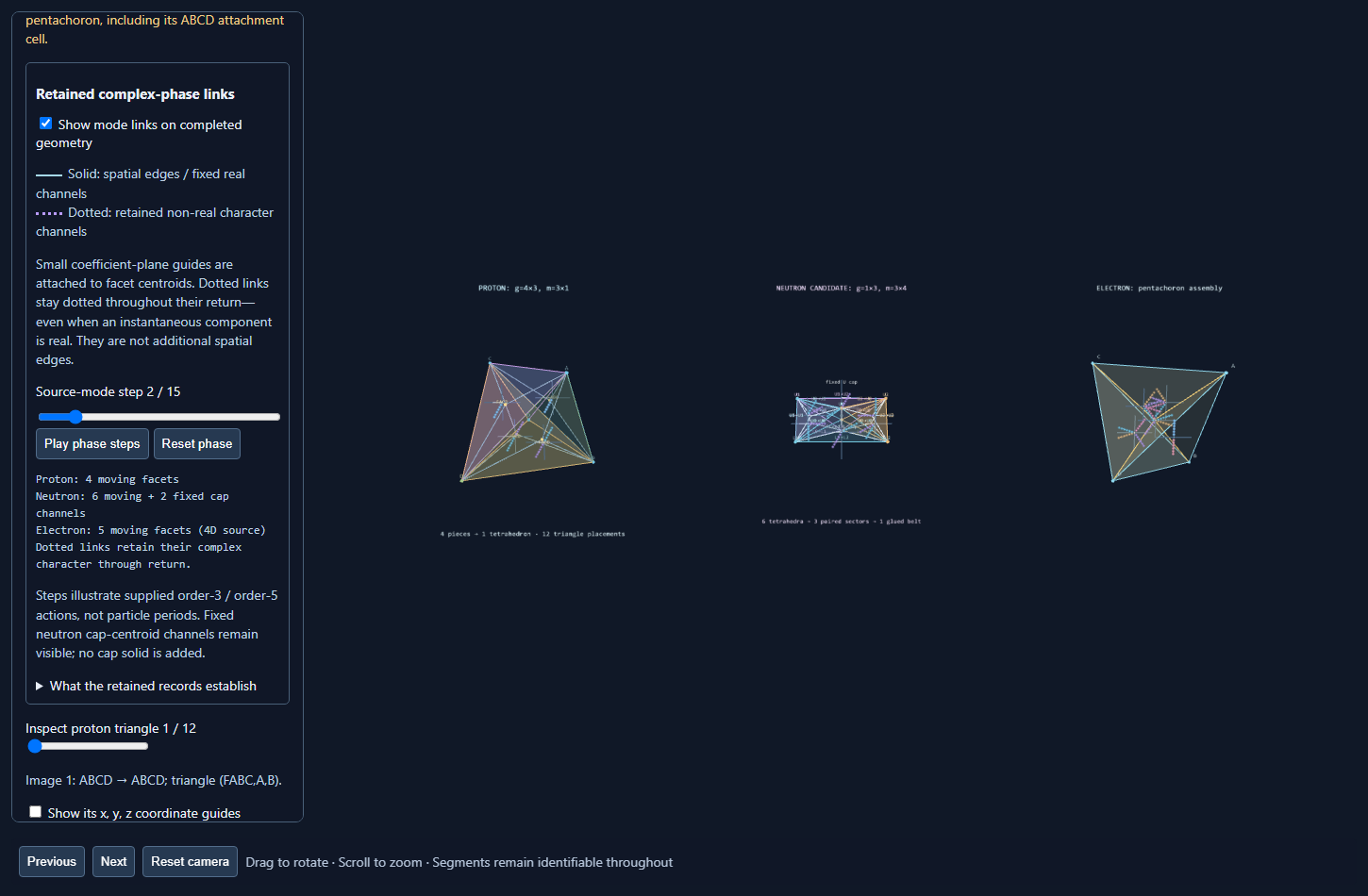 Geometry and retained phase linksSelect shapes and layers, reverse each seed generator to inspect anti candidates, or compare the photon’s retained two-face seed.
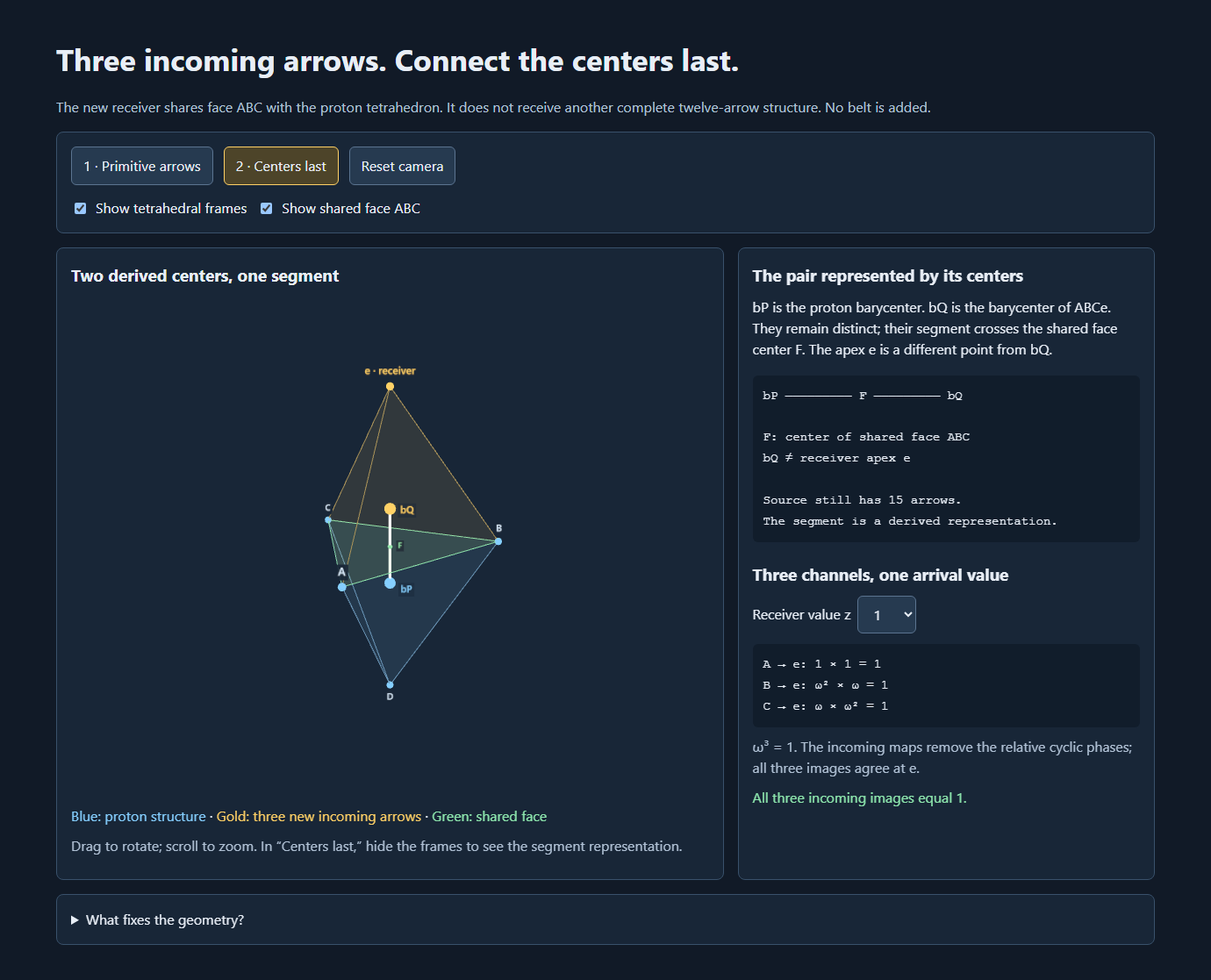 Three arrows; connect the centers lastSeparate the twelve inherited arrows, three incoming arrows, and a segment derived from the two barycenters.
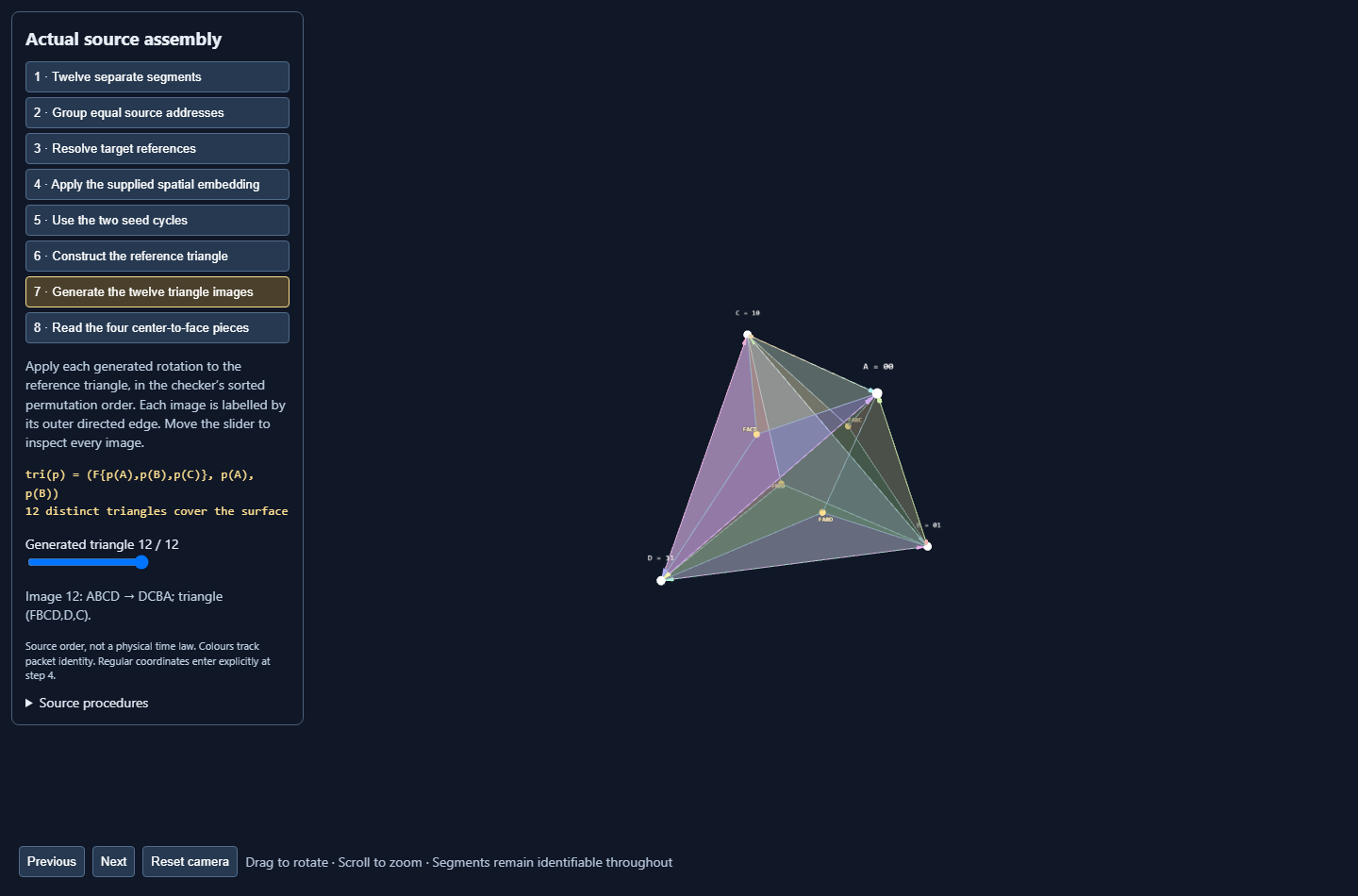 From packets to a tetrahedral presentationFollow eight stages: retained packet grouping, target wiring, supplied coordinates, seed rotations, triangle orbit, and derived face cones.
Information and readouts
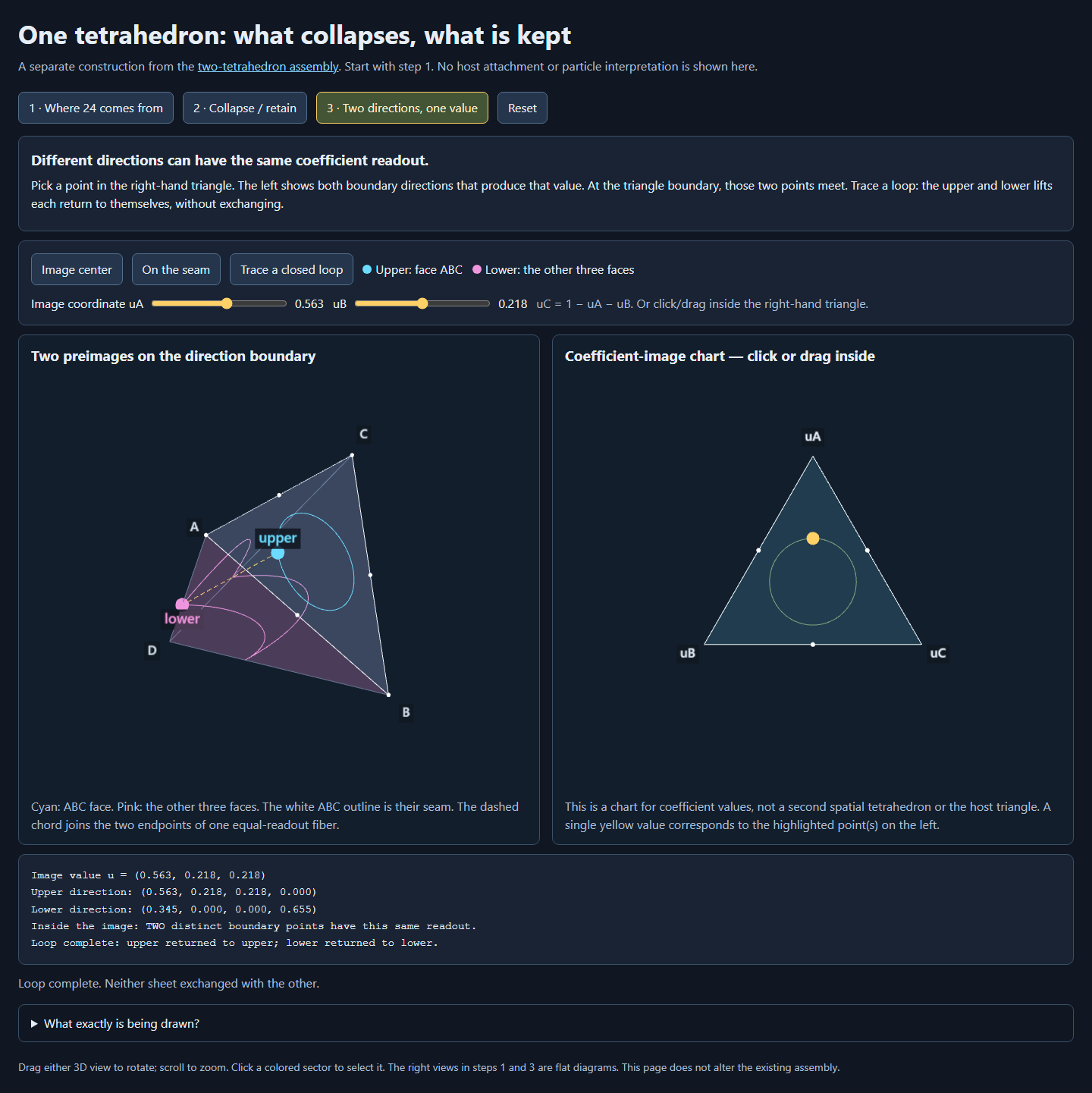 What collapses, what is retainedFollow 24 subdivision sectors, collapse to a center, and inspect different directions sharing one coefficient readout.
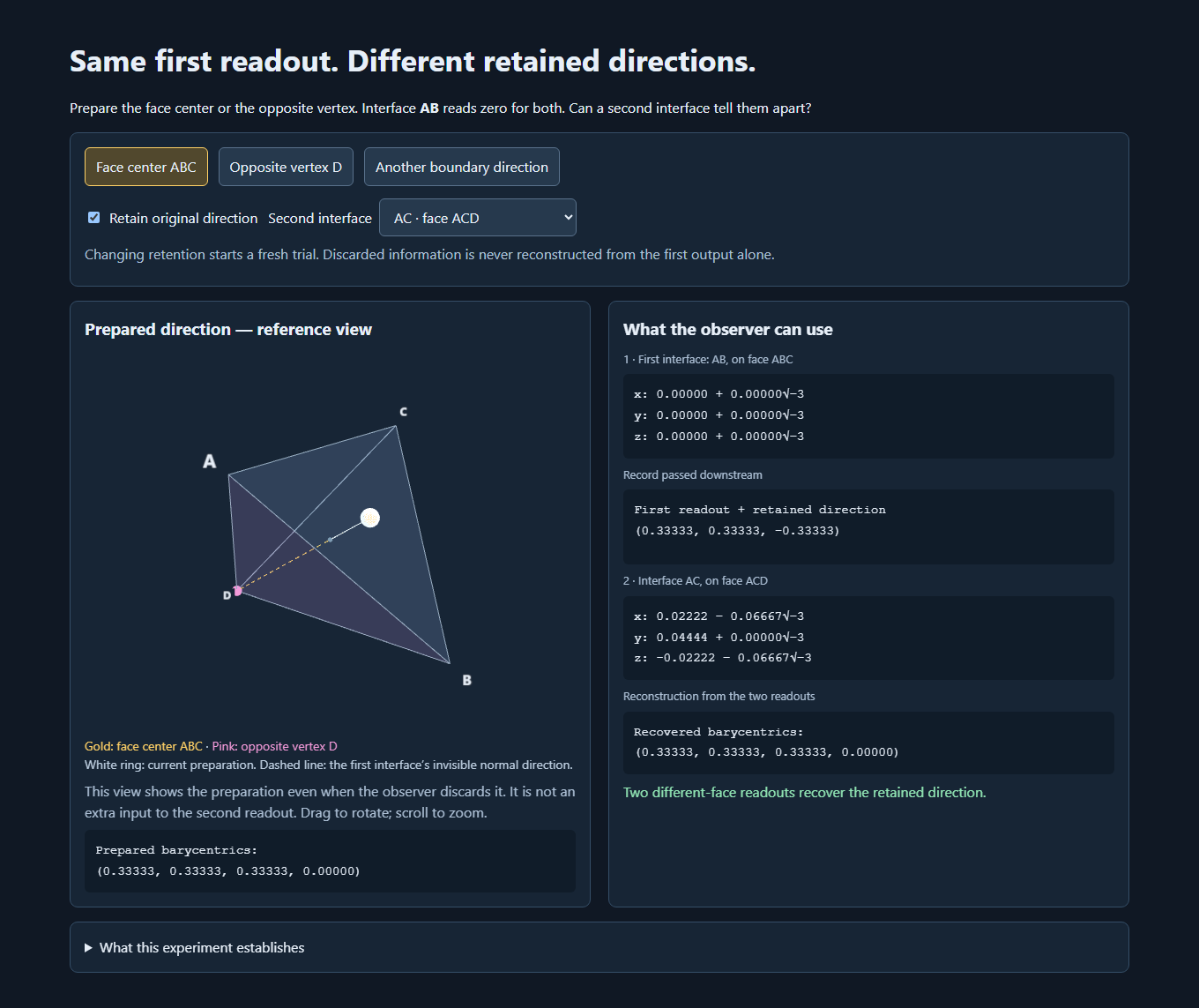 What a second interface can seeCompare equal first readouts, different-face reconstruction, and the information unavailable after discarding the original direction.
Spinor comparisons
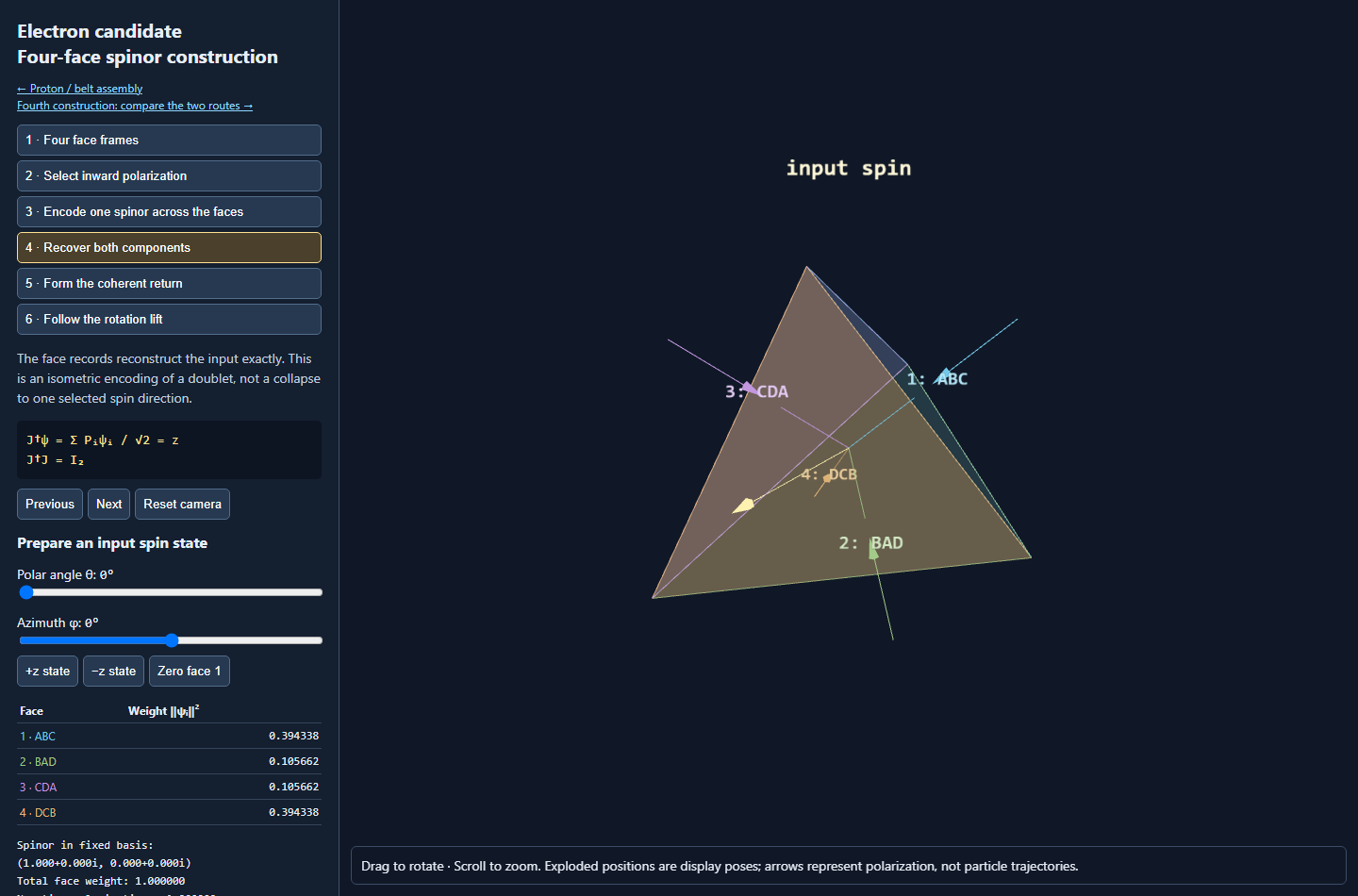 Four faces; retain both spinor componentsPrepare a doublet, inspect its face projections, reconstruct it, and follow the explicitly supplied rotation lift.
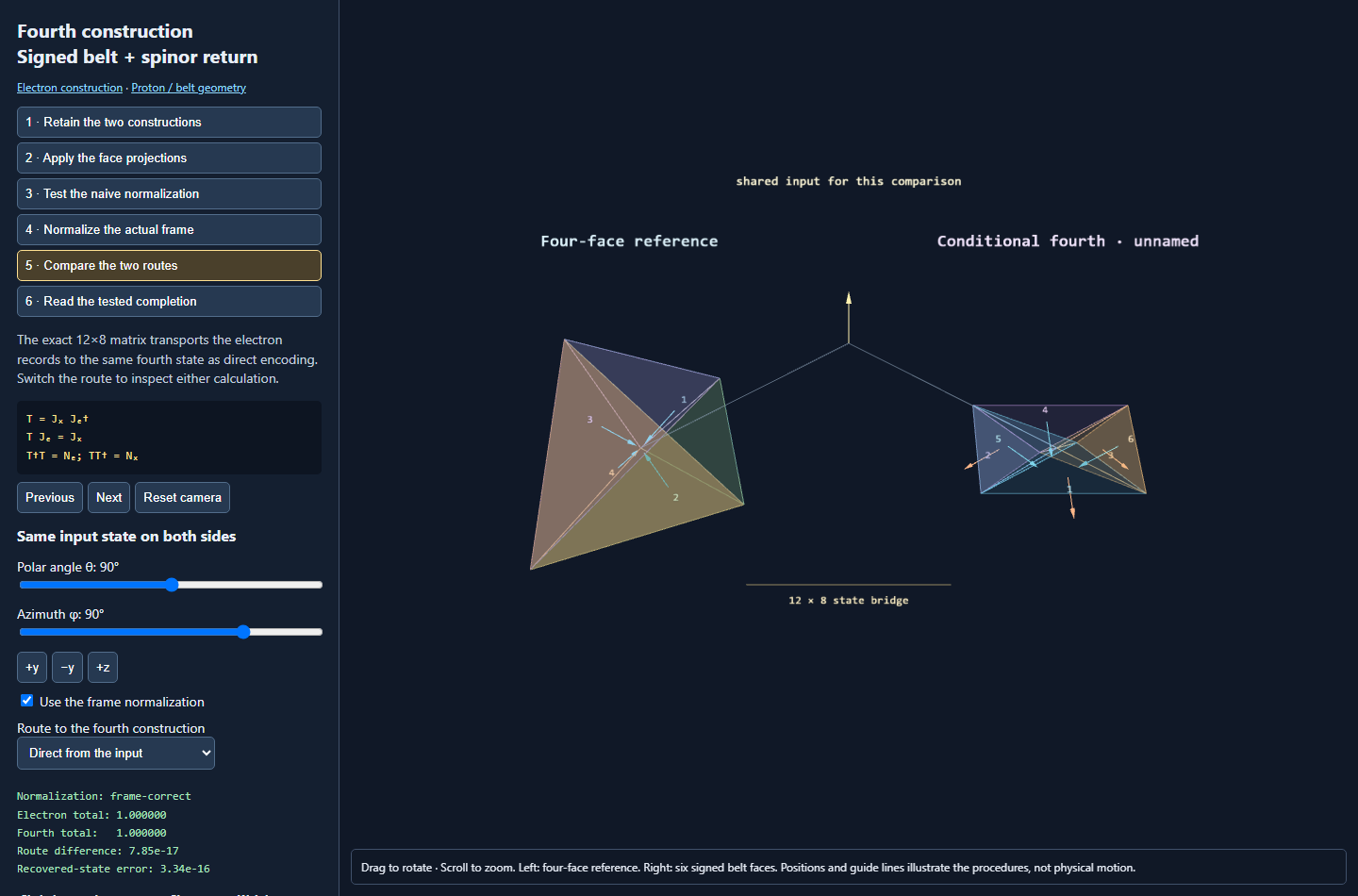 Signed belt and a lossless comparisonContrast a naive normalization with the actual frame correction, then compare direct and through-reference encodings.
Products and closure
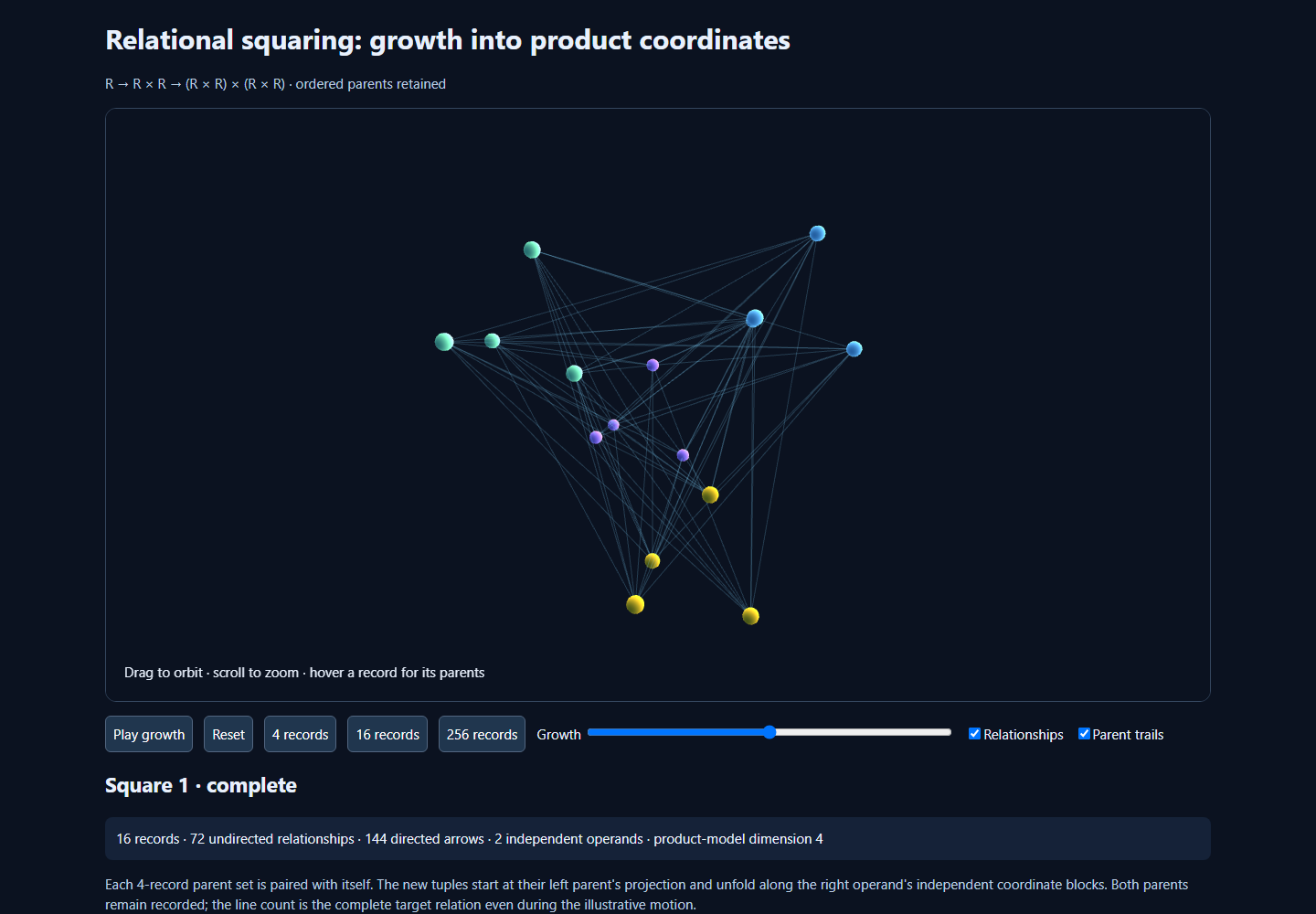 Independent products: 4 → 16 → 256 recordsTrack ordered parents and distinguish relation counts, embedding coordinates, and a three-dimensional display.
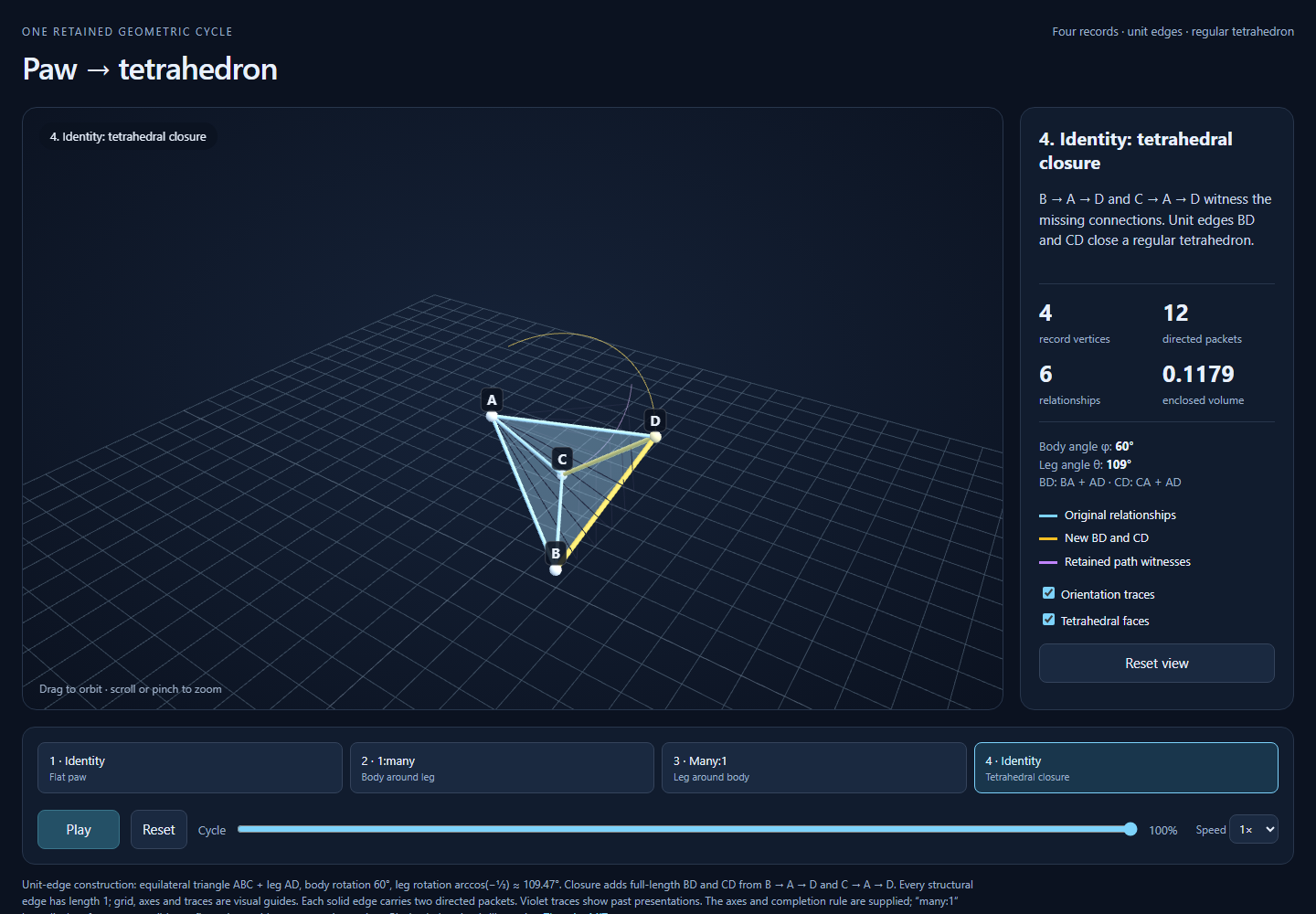 One paw; fixed-vertex tetrahedral closureFollow supplied rotations and completion paths without confusing this operation with independent-product growth.
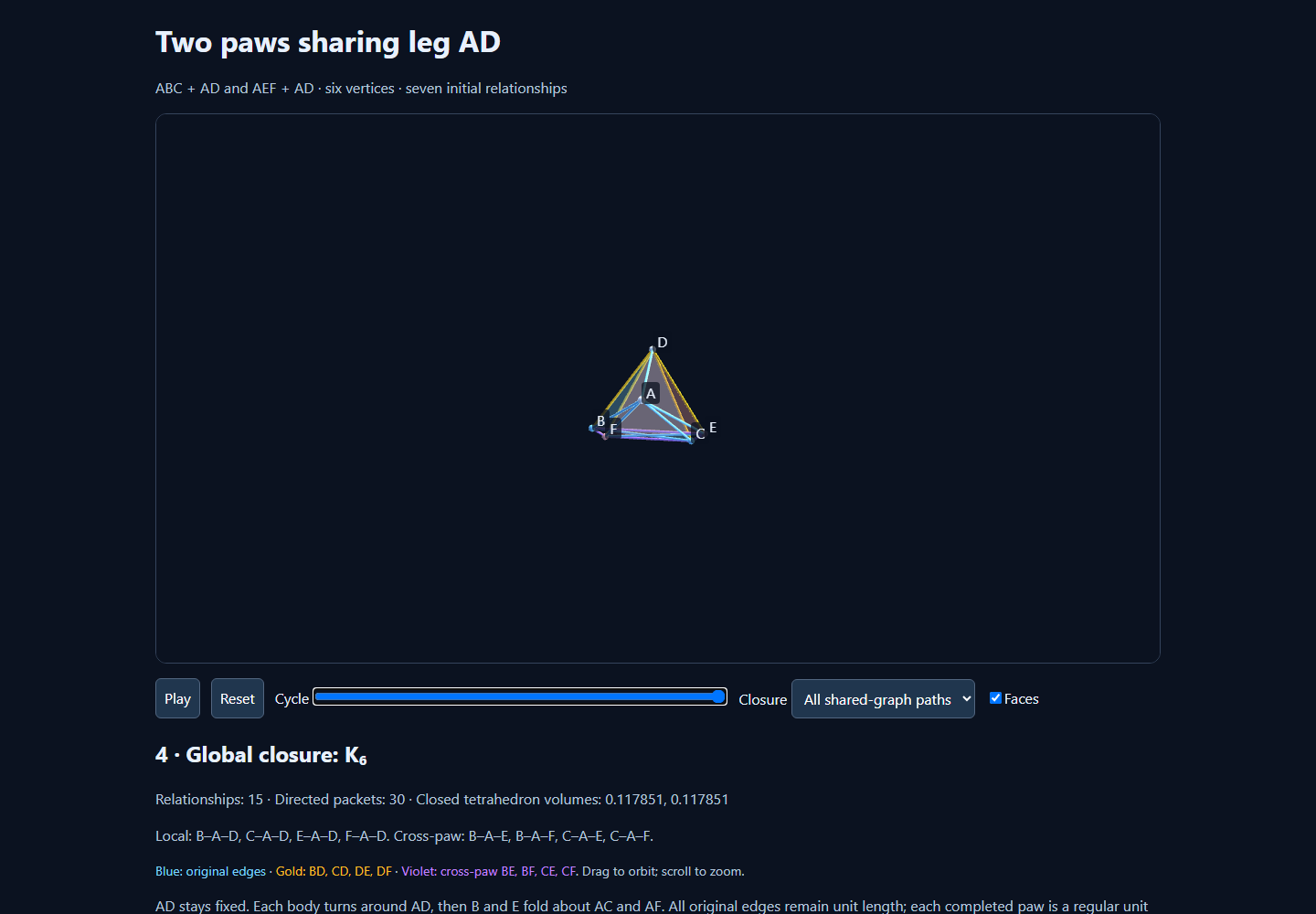 Two paws; choose the admission scopeCompare eleven local relationships with fifteen globally admitted relationships on the same six vertices.
Retained-information research lab
New source-backed comparisons from the October 12 research checkpoint. These diagrams and numerical readouts do not require WebGL. The symmetry viewer works offline once downloaded; the research lab loads its pinned same-site JSON snapshot. No new snapshots or particle shapes are implied.
Physical boundaries and programme status: Neutron rest energy: measured versus derived · What Coulomb binding adds · Accepted prerequisites, falsified branches and open programme outcomes.
The lab selects recorded cases and evaluates the source's explicit finite rank/endpoint rules; it does not run scientific suppliers. Full receipts and a source-hash manifest are downloadable. Publication/browser checks are not new research proofs or physical acceptance.
What each guide establishes
Assembly: the seed-arrow toggle highlights the proton's two generator cycles, the neutron's A→B→C→A and D→E→F→D rim orbits (one R⊕C affine action, carrier seeds A and D), and the electron's projected five-cycle with thick 3D shafts and heads; it does not fill the reserved neutron caps or invent a cross-rim translation arrow. The neutron uses the declared height h=7/20 and metric distance²=(r−s)²+|z−w|²; its real coordinate distinguishes the two cap centroids. Neutron R⊕C definition. The optional numbered neutrino hypotheses use explicit geometric realizations, not selected physical neutrino identities. Candidate #1 has the same local cyclic character as a proton face and no unmarked single attachment edge. The photon record retains the shared-edge ABC/BAD seed without CD, rather than the completed tetrahedron; selection as a separate emitted sector remains open. Two side-by-side copies show the normalized circular states
(1,+i)/√2and(1,−i)/√2, with coefficient charts and Jones/Stokes readouts. Paired polarization reversal applies(q,p) → (−p,−q), exchanging handedness while retaining the transported phases; two reversals restore the states. Chart phase is illustrative, not a physical time law. Polarization transport packet. Both are off by default and excluded from the hydrogen assemblies. Inverse seeds switches the selected matter families to antiproton, antineutron, positron, and antineutrino #1: geometry and source marks are preserved, each generator is inverted separately, and fixed vertices remain in the registered tables. Native coefficient protocols, charge conjugation, and physical antiparticle identifications are not supplied by this switch. Reversal packet. Photon packet · triangle selection and attachment. Metrics, seeds and symmetry actions for the sourced constructions are supplied. Dotted guides show normalized coefficient phases, not spatial displacement, energy or particle periods. The neutron and electron identifications remain candidates. Source and display contract.Fold explorer: retained direction data is stored explicitly; an ordinary collapsed point does not secretly contain it. The triangle is a coefficient-image chart, not a second spatial tetrahedron. The illustrated loop returns each sheet to itself; it is not a general transport theorem. Construction notes.
Receiver: equal edge lengths and an outward-side condition select the reflected apex. Phase compatibility alone does not determine that metric rule. The apex is not its barycenter, and the derived center segment is not a sixteenth primitive arrow. Geometry and verification.
Retained-direction observatory: two selected interfaces on different faces reconstruct the retained real direction; same-face interfaces share an invisible normal. The second interface accesses the original retained vector. Applying another projector to an already reduced output is a separate sequential operation and cannot recover discarded information. The reference picture is not an extra observer input. This is not a physical measurement-disturbance or time-evolution model. Exact calculation.
Source-assembly sequence: twelve directed packets are retained while matching addresses are grouped and wired. Regular coordinates and two seed cycles are supplied explicitly; their rotation orbit generates twelve centroid-edge triangles. Four center-to-face cones are a geometric decomposition, not four extra particles or a mass assignment. Stage order records construction dependencies, not a physical time law. Packet grouping and wiring · geometry and orbit checks.
Four-face spinor: face projections encode an explicitly supplied two-component state isometrically. The displayed 360° sign change and 720° return use a supplied spinor rotation lift and a retained reference, not a derivation of physical spin from geometry. Face polarization is not electric charge; coefficient-transfer counts are not mass. Construction boundary.
Fourth construction: positive frame normalization preserves both components and an explicit 12×8 bridge agrees with direct encoding. The isometry relates selected two-dimensional subspaces, not the entire raw coordinate spaces. Naive normalization can preserve route agreement while distorting the input. A common spinor frame is supplied; comparisons with the original proton and neutron returns remain missing. No particle name, charge or mass is assigned to the fourth return. Exact bridge and falsifiers.
Relational growth: independent products retain ordered parent tuples, with 4, 16, and 256 records. Coordinatewise off-diagonal compatibility selects the relation. The 3D display projects different embedding blocks; its dimensions are not the dimensions of the associated Dowker models. This is not the selected family-promotion architecture or a physical growth law. Product construction.
One paw cycle: four records remain fixed while supplied rotations and two completion paths add BD and CD. Axes, unit lengths, angles, and admission rules are inputs; playback is not physical time and the many-to-one stage is not an automatic quotient. Source demo.
Two-paw closure: local admission gives 11 edges, global admission 15, on the same six vertices. Cross-paw lengths are not generally unit lengths. The two shown hulls and individual volumes do not give a filled K6 or a union volume. Replaying the animation is not a second closure cycle. Source demo.
All 3D guides require WebGL. The newer workbenches also require network access to their Three.js dependencies; the three retained-product/paw demos bundle their dependencies and license locally. The observatory retains its numerical experiment if its 3D view is unavailable.
Diagrams and retained records
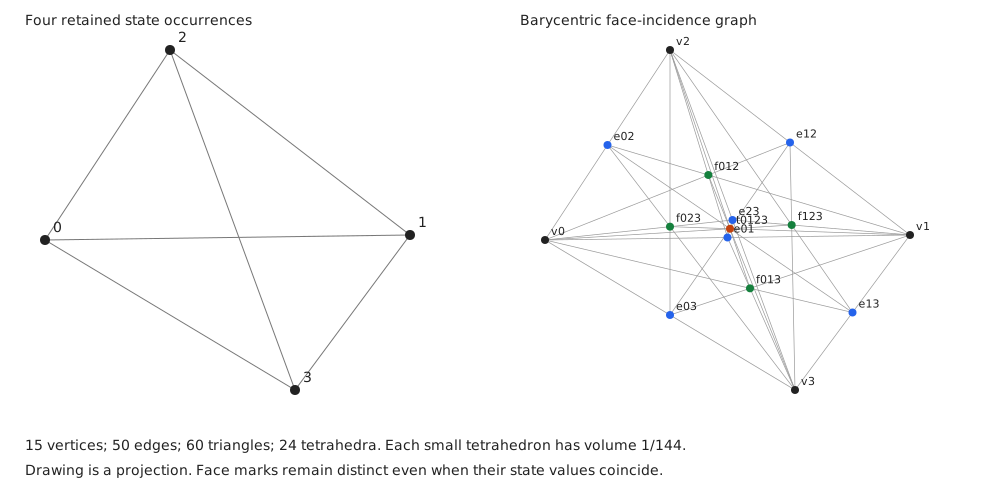
A barycentric witness packet → Read how a face becomes a presentation vertex while retaining its occurrence mark, witness type, and witness term. The static guide explains the 24-cell subdivision and why equal values or equal volume scores do not identify their sources. No WebGL is required.
Further exploration
The element and isotope catalogue separates observed properties from candidate models. Geometry, encoding, physical identification, and measured observables have separate verification obligations.
For current conclusions, read the results and exclusions and theory verification boundaries. Desktop and mobile browser checks exercise the published guides; they do not certify physical interpretations.