A barycentric witness packet
A static guide to one finite, typed tetrahedral presentation. This is an incidence construction—not a physical particle, a metric-selection law, or a theorem identifying arbitrary types with spatial points.
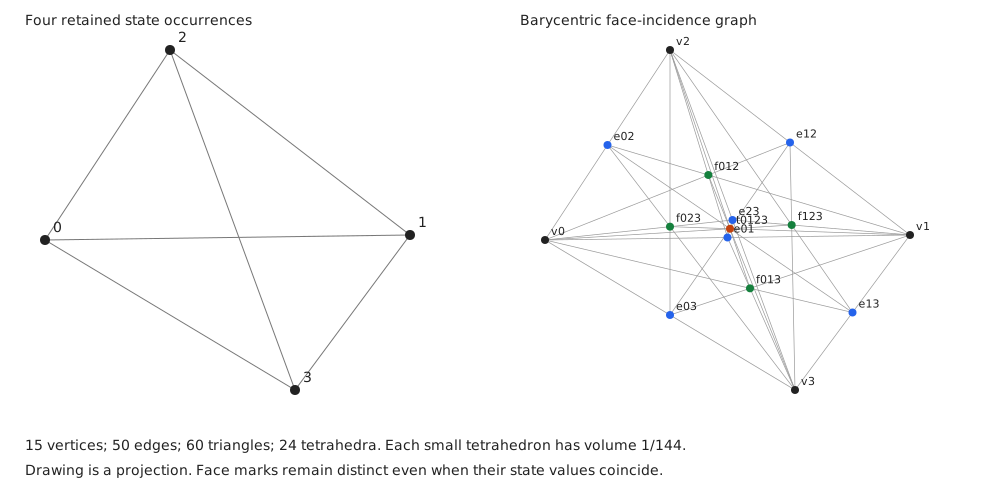
Reading the diagram
The left panel has four state occurrences, labelled 0–3. The right panel presents each nonempty face as a new marked vertex: four original vertices, six edges, four triangular faces, and the whole tetrahedron. Links connect strictly nested supports. Apparent crossings in this two-dimensional projection do not create extra incidences.
Each presentation vertex retains three fields: its face occurrence mark, its witness type, and its actual witness term. A triangular or tetrahedral witness can therefore be attached to a presentation vertex without erasing its original boundary role. The plotted affine coordinates illustrate the chosen realization; they do not replace the retained fields.
| Subdivision cells | Count |
|---|---|
| Vertices | 15 |
| Edges | 50 |
| Triangles | 60 |
| Tetrahedra | 24 |
The original affine tetrahedron has volume . Each of the 24 small tetrahedra has volume , so total volume is preserved. These are geometric scores in the declared coordinate convention, not energies or masses.
Two information-loss controls
- Equal typed values, distinct occurrences: in the concrete Boolean example, all four state occurrences have the same type and value. Those fields alone cannot recover their different occurrence marks. The positive construction retains the marks explicitly.
- Equal scores, distinct flags: all 24 maximal flags have volume . The score cannot select which flag produced it. The full flags are retained alongside their scores.
Evidence and boundary
The source reports Agda recovery proofs for face/type/term fields, an intended mark-erasure rejection, and exact rational checks for this finite subdivision, coordinates, orientations, and boundary cancellation. The SVG is a visualization of that evidence, not a fresh proof certificate or a machine-checked subdivision theorem for arbitrary complexes. Physical geometry, automatic contraction, and active-view clearing are not supplied.
Research explanation and verification · exact finite checker · retained-witness glossary · construction gallery