Marici · Relational constructions and physical hypotheses
Marici investigates whether relational carriers and retained witnesses can constrain physical states, interactions, and readouts. The programme develops exact constructions, formal proofs, conditional models, and tests of proposed identifications. It has not established a replacement for the Standard Model or general relativity, or derived their measured parameters from one object.
A Witness Generator returns an output with a typed witness relating it to its input. That interface alone does not supply physical dynamics, an energy law, or a rule selecting every proposed domain view.
Start here
- Theory: explanations, definitions, and the boundaries of proposed physical interpretations.
- Architecture: record structures, construction contracts, inputs, and assumptions.
- Results: what has been checked, what is excluded, and what remains open.
- Constructions: visual guides and interactive workbenches.
- Research ledger: the dated record behind the current synthesis.
Current frontier: October 8–10, 2026
Source-controlled geometric assembly
One orbit/facet/cone procedure reconstructs the tetrahedral, six-panel belt, and pentachoron candidates, retaining their attachment interfaces. Metrics, symmetry actions, and seed data are explicit inputs—not predictions of physical particles. Reversible centroid modes preserve their metric budget and history.
The successful admission rule operates on maximal supporting facets. Applying it to arbitrary refined cells restores the neutron caps and gives 24 triangles instead of 18. The source-controlled construction does not establish a universal dimensional reset or derive particle periods.
Common assembly and its counterexample, entry 4319.
Operational analytic formalization
The research reports fresh safe Agda closure for completion-valued phase norm, metric regularity, unit-circle flow, and an assembled operational half-turn. Its identification with standard pi remains an explicitly accepted written proof, distinct from the kernel-checked operational laws. Standard-complex external whole-return existence and its operational completion implementation also have different verification levels; whole-return assembly remains open in the cited completion net.
Half-turn construction and scope · current completion net.
Energy, coupling, and binding: positive models and exclusions
Source-weighted matter/link dynamics now account for exterior field energy against a common empty reference. But belt–proton energy ordering changes with exterior conductance. Internal norm-charge is not identified with electric charge, and an excitation gap is not automatically rest mass.
Two discriminating negative results are retained:
- The specified shared charging/displacement law cannot match both the proton/electron mass ratio and the neutron–proton splitting. Retuning its common strength or clock does not repair that branch.
- The present deuterium common-vacuum graph gives repulsion with separate reservoirs or zero binding with the same total reservoir. Typed constituent ports alone do not supply an attractive interaction.
A conditional spinor quantum model supplies an exact invariant 16-dimensional simulation sector, not a calibrated device or a particle identification. A neutral bilinear spinor pairing supplies an opposite-phase condition only after neutrality and charge normalization are declared.
Energy and boundary dependence, entry 4317 · mass-branch exclusion · breakup test · quantum model.
Explore the constructions
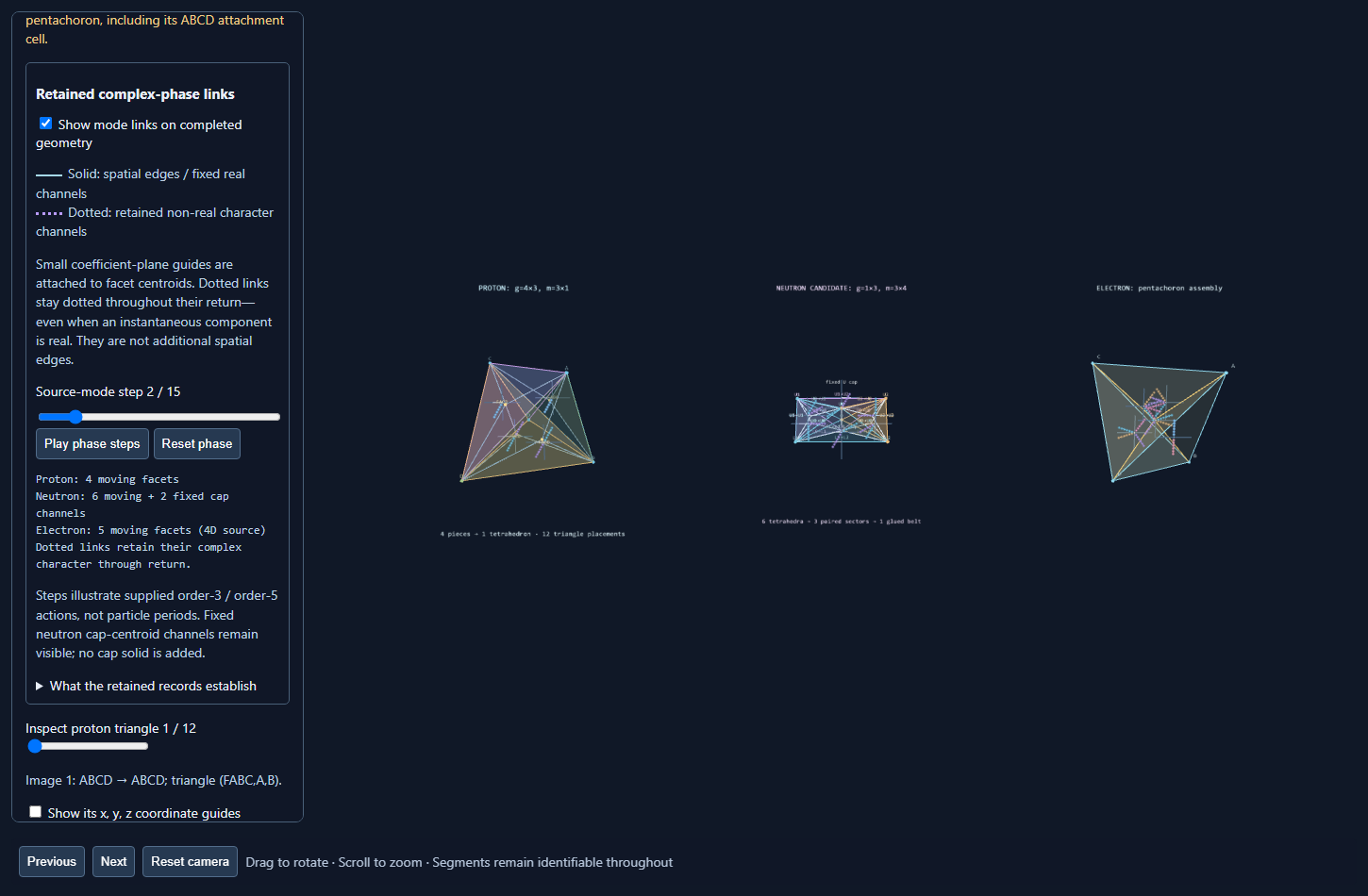
Open the geometry and phase-link workbench → Explore declared assembly stages and distinguish solid spatial edges from dotted coefficient-phase guides. These are candidate mathematical constructions, not established particles, energy scales, or binding laws.
Browse the construction gallery → Choose from geometry and assembly, information and readouts, spinor comparisons, independent products and paw closure, or a static witness diagram. These are separate construction families, not steps in one physical sequence. Previews open full-screen interactives rather than embedding dense controls here.
Matter research atlas
Explore the isotope and mechanism registry →
Current coverage includes hydrogen-1 and hydrogen-2, constituent candidates, and linked mass, charge, coupling, and memory mechanisms. Observed isotope properties are separate from geometric constructions and conditional models. Input masses or binding energies used in accounting are not independently predicted; binding and isotope-stability explanations remain open. Mechanism links indicate relevance, not completed physical identification.
Standard Model reference graph displays conventional field species and interaction families separately from Marici's conjectural constructions.
Carrier, overlap, and the proposed ladder
The four-element carrier has set automorphism group . Declared probes and an inner product define a positive semidefinite Hermitian Gram matrix . The symmetry of the underlying set does not by itself select the probes, their measure, or their physical meaning.
If a Gram is invariant under every carrier permutation, it has a common diagonal and a common off-diagonal entry. For diagonal and off-diagonal one,
where is the all-ones matrix. On four points its eigenvalues are once and three times. Setting is a model choice: these eigenvalues are 15 and 11, with gap 4. The counts of directed pairs (12), undirected pairs (6), and real symmetric matrix entries (10) are arithmetic facts, not derived gauge couplings or generation counts. The natural permutation representation is , not a singlet–singlet–doublet split.
The explicit stabilizer-indicator realization on one fixed probe space instead gives under restriction, with norm eigenvalues and 10. It must not be conflated with the four-point example or with the assigned numbers .
The proposed ladder organizes several research models. Gram-orthogonal restriction has exact retained-plus-record norm identities when the probes are independent. Family promotion is a different operation that retains grouped records under fresh labels. Neither a chosen four-point floor nor rank reduction selects a physical energy, gauge group, or measured constant. The specified transports , , have checked retained-record candidates, but their intended physical generator and rung-4 readout remain to be identified.
Fixed-carrier Gram construction · comparison-tower checks · transport diagram and assumptions.
Retained comparisons and verification
- 137: the specified comparison domain has 121 arrow–arrow slots and 16 state–state slots. Equal-slot averaging and conditional equilibrium mismatch shares are not an electromagnetic coupling derivation. The exploratory inverse-coupling value 137.036195934 fails the quoted precision recoil targets. Interpretation and precision outcome.
- 1836: both a comparison programme and a specified tetrahedral coefficient network have this count. The latter is pruning-minimal under fixed-weight deletion, not under unrestricted refactoring or reweighting. Neither derives the observed mass ratio. Construction and mass boundary.
- Spin and charge: the binary tetrahedral bridge is checked; the native endpoint/filter spinor-selection test fails. Declared spinor extensions and opposite-phase pairing are additional constructions, not a reversal of that failure. Spin and charge audit.
- Merkle witnesses: content hashes bind records and dependencies; dedicated verifiers separately check identities, gluing, global transport, and explicit fillers. Surface closure does not prove that a filler exists, and local flatness does not imply trivial global holonomy. Bounded prototypes, entry 4313.
Arithmetic and cosmology comparison frontier
Finite Tate residue-to-radial incidence has exact adjoint/Fourier structure and a uniform gap on its nonzero active sectors. Arithmetic packet normalization and global completion remain separate obligations. The nine-state circuit resolution is not yet identified with the marked-relative cosmology module; its source-labelled comparison and equivariant descent data are still required.
Local theorem and remaining comparison.
Predictions and comparison targets
These are proposed numerical expressions, not established physical predictions. Exact arithmetic does not select an observable, units, normalization, or dynamics. A statistical comparison requires independently sourced measurements, scale and scheme conventions, and experimental and theoretical uncertainty. The earlier fixed “falsified if” windows were not a justified uncertainty model and are withdrawn. Rejection of a specified expression does not automatically reject the programme.
| Comparison area | Candidate expression or count | What is still missing |
|---|---|---|
| Cosmological curvature | , the deficit of the proposed density budget. | A cosmological dynamics and sector-specific curvature readout; it is not selected by arithmetic closure alone. |
| Neutrino and quark phases | ; . | Source-selected mixing operators and phase conventions. A ratio of chosen numbers is not a flavor derivation. |
| Proton/electron mass | . | Physical states, a common mass observable, and the fractional correction to the retained approximately 1836.152673 measurement target. The common charging branch is excluded, not repaired by that count. |
| Higgs mass and vev | ; . | A derived Higgs sector and dimensional normalization before assigning GeV units. |
| Electromagnetic and weak coupling | 137 comparison slots; candidate weak fraction . | A charge/field normalization and scale-matched observable. The electromagnetic routing trial fails precision; the cited weak matter-trace derivation fails colour counting. |
| Dark matter and gravity | Candidate density and feedback factor . | A selected dark-sector mechanism and gravitational action. This factor does not by itself predict a variation of or force sterile-neutrino and modified-inertia explanations to be mutually exclusive. |
No new quantitative physical prediction is established by the October 8–10 constructions. Several model branches are positively tested and several are excluded, each within its declared scope.
Detailed results and exclusions · weak-mixing audit.
Construction and formalizations
Proofs, models, and next tests
Kernel-checked formal laws, written mathematical arguments, exact finite checks, numerical diagnostics, and prospective apparatus designs have different evidentiary roles. A proof of an integer identity or a supplied Hamiltonian's properties is not a proof of its physical interpretation. Proof-file totals are not a measure of completed physics.
The next discriminating work is to complete the separately scoped operational whole-return certificate, supply independently justified physical current/charge and clock/energy standards, and test a stable cross-carrier interaction with identical composite/breakup accounting. Record architecture, conditional feedback, and retained memory remain separately specified until their source and observation adapters are constructed.
Full theory and verification boundaries · research status and next tests · architecture and construction contracts.